Showing posts with label Alcohol. Show all posts

Saturday, March 29, 2014

NECTOR OF DEVOTION
Chapter 29: Intoxication

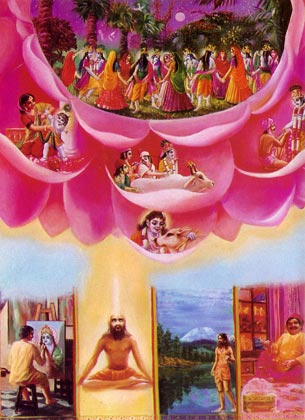
When one becomes arrogant with false prestige due to drinking intoxicants or being too lustful, the voice becomes faulty, the eyes become swollen, and there are symptoms of redness on the body. There is a statement in the Lalita-mādhava that Lord Baladeva, intoxicated from drinking excessive quantities of honey, once began to address the ants, "O you kings of the ants! Why are you hiding yourselves in these holes?" At the same time He also addressed the King of heaven, "O King Indra! You plaything of Śacī! Why are you laughing? I am now prepared to smash the whole universe, and I know that Kṛṣṇa will not be angry with Me."* Then He addressed Kṛṣṇa, "My dear Kṛṣṇa, tell Me immediately why the whole world is trembling and why the moon has become elongated! And O you members of the Yadu dynasty, why are you laughing at Me? Please give Me back My liquors made of honey from the kadamba flower!" Śrīla Rūpa Gosvāmī prays that Lord Balarāma will be pleased with all of us while He is thus talking just like an intoxicated person.

In this state of intoxication, Balarāma felt tired and lay down for rest. Generally, those who are exalted personalities lie down when they feel intoxicated, whereas those who are mediocre laugh and sing during intoxication, and those who are lowly use vulgar language and sometimes cry. Such intoxication is manifested according to different ages and mentalities. Śrīla Rūpa Gosvāmī does not describe further in this direction because there is no necessity for such a discussion.

There is another description of the symptoms of intoxication in the person of Śrī Rādhārāṇī after She saw Kṛṣṇa. Sometimes She was walking hither and thither, sometimes She was laughing, sometimes She was covering Her face, sometimes She was talking without any meaning, and sometimes She was praying to Her associate gopīs. Seeing these symptoms in Rādhārāṇī, the gopīs began to talk among themselves: "Just see how Rādhārāṇī has become intoxicated simply by seeing Kṛṣṇa before Her!" This is an instance of ecstatic love in intoxication.

Monday, September 10, 2012

SLOKA OF THE DAY:

Bhagavad Gita As It Is -
Chapter 3 Text 36

arjuna uvaca
atha kena prayukto 'yam
papam carati purusah
anicchann api varsneya
balad iva ni yojitah

arjunah uvaca--Arjuna said; atha--then; kena--by what; prayuktah--impelled; ayam--one; papam--sins; carati--does; purusah--a man; anicchan--without desiring; api--although; varsneya--O descendant of Vrsni; balat--by force; iva--as if; niyojitah--engaged.

TRANSLATION

Arjuna said: O descendant of Vrsni, by what is one impelled to sinful acts, even unwillingly, as if engaged by force?

JOURNAL:

This sloka reminds me of the last days of my drinking. This is the question we ask ourselves just before we get sober. The First Step of AA phrases it this way; . . . our lives had become unmanageable.

Thursday, August 23, 2012

SLOKA OF THE DAY:

Bhagavad Gita As It Is -
Chapter 3 Text 24

utsideyur ime loka
na kuryam karma ced aham
sankarasya ca karta syam
upahanyam imah prajah

utsideyuh--would be put into ruin; ime--all these; lokah--worlds; na--not; kuryam--I perform; karma--prescribed duties; cet--if; aham--I; sankarasya--of unwanted population; ca--and; karta--creator; syam--would be; upahanyam--would destroy; imah--all these; prajah--living entities.

TRANSLATION

If I did not perform prescribed duties, all these worlds would be put to ruination. I would be the cause of creating unwanted population, and I would thereby destroy the peace of all living beings.

PURPORT (excerpts)

Therefore, whenever there is general disregard of regulative principles, the Lord Himself descends and corrects the society.

"One should simply follow the instructions of the Lord and His empowered servants. Their instructions are all good for us, and any intelligent person will perform them as instructed. However, one should guard against trying to imitate their actions. One should not try to drink the ocean of poison in imitation of Lord Siva."
(SB 10.33.30-31)

There are many pseudo devotees of Lord Siva who want to indulge in smoking ganja (marijuana) and similar intoxicating drugs, forgetting that by so imitating the acts of Lord Siva they are calling death very near. Similarly, there are some pseudo devotees of Lord Krsna who prefer to imitate the Lord in His rasa-lila, or dance of love, forgetting their inability to lift Govardhana Hill. It is best, therefore, that one not try to imitate the powerful, but simply follow their instructions;

Monday, July 30, 2012

SLOKA OF THE DAY:

Bhagavad Gita As It Is -
Chapter 3 Text 6

karmendriyani samyamya
ya aste manasa smaran
indriyarthan vimudhatma
mithyacarah sa ucyate

karma-indriyani--the five working sense organs; samyamya--controlling; yah--anyone who; aste--remains; manasa--by the mind; smaran--thinking of; indriya-arthan--sense objects; vimudha--foolish; atma--soul; mithya-acarah--pretender; sah--he; ucyate--is called.

TRANSLATION

One who restrains the senses of action but whose mind dwells on sense objects certainly deludes himself and is called a pretender.

JOURNAL:

Enlightenment's supposed to come with the prayer, not before it. -J.D. Salinger - "Franny and Zooey".

Fake it 'till you make it. -An AA saying.

One achieves bhakti by hearing and chanting about the Supreme Lord's special qualities, even while engaged in the ordinary activities of life in this world. -Nārada Bhakti Sūtra 37.

This sloka seems to be a warning to us who have begun our walk with the Lord. I am not a big fan of the AA saying but, if it keeps one "coming back", then it is good.

Let us not use God's mercy as an excuse for our behaviors!

Wednesday, July 4, 2012

SLOKA OF THE DAY

Bhagavad Gita As It Is -
Chapter 2 Text 60

yatato hy api kaunteya
purusasya vipascitah
indriyani pramathini
haranti prasabham manah

yatatah--while endeavoring; hi--certainly; api--in spite of; kaunteya--O son of Kunti; purusasya--of a man; vipascitah--full of discriminating knowledge; indriyani--the senses; pramathini--agitating; haranti--throw; prasabham--by force; manah--the mind.

TRANSLATION

The senses are so strong and impetuous, O Arjuna, that they forcibly carry away the mind even of a man of discrimination who is endeavoring to control them.

JOURNAL:

I read this sloka and I wonder why there is so much surprise when a fall down occurs in ISKCON.

There is a nice quote in the book Alcoholics Anonymous on page 68 that I find comforting. It reads; We are in the world to play the role He assigns. Just to the extent that we do as we think He would have us, and humbly rely on Him, does He enable us to match calamity with serenity.

Tuesday, June 19, 2012

SLOKA OF THE DAY:

Bhagavad Gita As It Is -
Chapter 2 Text 49

durena hy avaram karma
buddhi-yogad dhananjaya
buddhau saranam anviccha
krpanah phala-hetavah


durena--discard it at a long distance; hi--certainly; avaram--abominable; karma--activity; buddhi-yogat--on the strength of Krsna consciousness; dhananjaya--O conqueror of wealth; buddhau--in such consciousness; saranam--full surrender; anviccha--try for; krpanah--misers; phala-hetavah--those desiring fruitive results.

TRANSLATION

O Dhananjaya, keep all abominable activities far distant by devotional service, and in that consciousness surrender unto the Lord. Those who want to enjoy the fruits of their work are misers.

JOURNAL:

I used to drink alcohol on a regular basis. As I began to take my devotional life more seriously I found it hard to stop drinking. So I began attending Alcoholics Anonymous and, when the cravings came, chanting the maha-mantra. This is when I learned to cry to the Lord.

Monday, June 11, 2012

SLOKA OF THE DAY:

Bhagavad Gita As It Is -
Chapter 2 Text 42-43

yam imam puspitam vacam
pravadanty avipascitah
veda-vada-ratah partha
nanyad astiti vadinah

kamatmanah svarga-para
janma-karma-phala-pradam
kriya-visesa-bahulam
bhogaisvarya-gatim prati

yam imam--all these; puspitam--flowery; vacam--words; pravadanti--say; avipascitah--men with a poor fund of knowledge; veda-vada-ratah--supposed followers of the Vedas; partha--O son of Prtha; na--never; anyat--anything else; asti--there is; iti--thus; vadinah--the advocates; kama-atmanah--desirous of sense gratification; svarga-parah--aiming to achieve heavenly planets; janma-karma-phala-pradam--resulting in good birth and other fruitive reactions; kriya-visesa--pompous ceremonies; bahulam--various; bhoga--in sense enjoyment; aisvarya--and opulence; gatim--progress; prati--towards.

TRANSLATION

Men of small knowledge are very much attached to the flowery words of the Vedas, which recommend various fruitive activities for elevation to heavenly planets, resultant good birth, power, and so forth. Being desirous of sense gratification and opulent life, they say that there is nothing more than this.

JOURNAL:

Srila Prabhupada ends his purport thus; .It is understood that there are gardens called Nandana-kanana in which there is good opportunity for association with angelic, beautiful women and having a profuse supply of soma-rasa wine. Such bodily happiness is certainly sensual; therefore there are those who are purely attached to such material, temporary happiness, as lords of the material world. This sure sounds like a description of an alcoholic to me.

Saturday, March 17, 2012

SLOKA OF THE WEEK:

Śrīmad Bhāgavatam 5.13.17

tair vañcito hamsa-kulam samāvisann
arocayan śīlam upaiti vānarān
taj-jāti-rāsena sunirvrtendriyah
parasparodvīksana-vismrtāvadhih

taih — by them (the cheaters and pretenders, the so-called yogīs, svāmīs, incarnations and gurus); vañcitah — being cheated; hamsa-kulam — the association of great paramahamsas, or devotees; samāvisan — contacting; arocayan — not being satisfied with; śīlam — their behavior; upaiti — approaches; vānarān — the monkeys, which are all debauchees with no good character; tat-jāti-rāsena — by sense gratification in the association of such debauchees; sunirvrta-indriyah — being very satisfied with getting the opportunity of sense gratification; paraspara — of one another; udvīksana — by seeing the faces; vismrta — who has forgotten; avadhih — the end of life.

TRANSLATION

Being cheated by them, the living entity in the forest of the material world tries to give up the association of these so-called yogīs, svāmīs and incarnations and come to the association of real devotees, but due to misfortune he cannot follow the instructions of the spiritual master or advanced devotees; therefore he gives up their company and again returns to the association of monkeys who are simply interested in sense gratification and women. He derives satisfaction by associating with sense gratifiers and enjoying sex and intoxication. In this way he spoils his life simply by indulging in sex and intoxication. Looking into the faces of other sense gratifiers, he becomes forgetful and thus approaches death.

JOURNAL:

Today is Saint Patrick's Day. Here in the United States millions of people will go get drunk. Normally, a day set aside for a Catholic saint is observed by fasting but this poor fellow is celebrated by green beer and craziness. Thus, I thought this sloka was particularly appropriate.

Wednesday, December 28, 2011

SLOKA OF THE DAY:

Bhagavad Gita As It Is -
Chapter 18 Text 38

visayendriya-samyogad
yat tad agre 'mrtopamam
pariname visam iva
tat sukham rajasam smrtam

visaya--of the objects of the senses; indriya--and the senses; samyogat--from the combination; yat--which; tat--that; agre--in the beginning; amrta-upamam--just like nectar; pariname--at the end; visam iva--like poison; tat--that; sukham--happiness; rajasam--in the mode of passion; smrtam--is considered.

TRANSLATION

That happiness which is derived from contact of the senses with their objects and which appears like nectar at first but poison at the end is said to be of the nature of passion.

JOURNAL:

This sloka could be a description of my use of alcohol. When I used to drink it would feel so good at the start but, being an alcoholic, I could never stop after just one or two and would wake up with terrible hangovers from alcohol poisoning. Thank God those days are over!

Tuesday, July 19, 2011

SLOKA OF THE DAY:

Bhagavad Gita As It Is -
Chapter 14 Text 17

sattvat sanjayate jnanam
rajaso lobha eva ca
pramada-mohau tamaso
bhavato 'jnanam eva ca

sattvat--from the mode of goodness; sanjayate--develops; jnanam--knowledge; rajasah--from the mode of passion; lobhah--greed; eva--certainly; ca--also; pramada--madness; mohau--and illusion; tamasah--from the mode of ignorance; bhavatah--develop; ajnanam--nonsense; eva--certainly; ca--also.

TRANSLATION

From the mode of goodness, real knowledge develops; from the mode of passion, greed develops; and from the mode of ignorance develop foolishness, madness and illusion.

JOURNAL:

Srila Prabhupada opens his purport with these words; Since the present civilization is not very congenial to the living entities, Krsna consciousness is recommended. Through Krsna consciousness, society will develop the mode of goodness. When the mode of goodness is developed, people will see things as they are.

Seeing "things as they are" involves practicing seeing Krishna everywhere. Everything is the Lord's energy and he is the spark, or the soul, of everything alive.

At the end of his purport he states; When one is engaged in the mode of passion, not only is he mentally unhappy, but his profession and occupation are also very troublesome. He has to devise so many plans and schemes to acquire enough money to maintain his status quo. This is all miserable. In the mode of ignorance, people become mad. Being distressed by their circumstances, they take shelter of intoxication, and thus they sink further into ignorance. Their future in life is very dark.

Every day out here on the road I see this state of affairs. The homeless sink into despair and turn to drugs and alcohol to blot out their miserable existence. They become so mad that they actually think that they have more freedom than the man in the mode of passion who works hard every day. Some of these at least go to church on Sunday and pray that God will have pity on them.

Thursday, May 26, 2011

SLOKA OF THE DAY:

Bhagavad Gita As It Is -
Chapter 13 Text 14

sarvatah pani-padam tat
sarvato 'ksi-siro-mukham
sarvatah srutimal loke
sarvam avrtya tisthati

sarvatah--everywhere; pani--hands; padam--legs; tat--that; sarvatah--everywhere; aksi--eyes; sirah--heads; mukham--faces; sarvatah--everywhere; sruti-mat--having ears; loke--in the world; sarvam--everything; avrtya--covering; tisthati--exists.

TRANSLATION

Everywhere are His hands and legs, His eyes, heads and faces, and He has ears everywhere. In this way the Supersoul exists, pervading everything.

JOURNAL:

I attend Alcoholic Anonymous meetings. At most of them the tradition is to close with the Lord's Prayer and people like to introduce it differently. Some just say; "Who's Father?", some like to be creative; "Let this circle represent what we can do together that we can not do alone.", and some like to be humorous; "Who sees us naked in the shower?"

Friday, November 5, 2010

SLOKA OF THE DAY:

Bhagavad Gita As It Is -
Chapter 9 Text 20

trai-vidya mam soma-pah puta-papa
yajnair istva svar-gatim prarthayante
te punyam asadya surendra-lokam
asnanti divyan divi deva-bhogan

trai-vidyah--the knowers of the three Vedas; mam--Me; soma-pah--drinkers of soma juice; puta--purified; papah--of sins; yajnaih--with sacrifices; istva--worshiping; svah-gatim--passage to heaven; prarthayante--pray for; te--they; punyam--pious; asadya--attaining; sura-indra--of Indra; lokam--the world; asnanti--enjoy; divyan--celestial; divi--in heaven; deva-bhogan--the pleasures of the gods.

TRANSLATION

Those who study the Vedas and drink the soma juice, seeking the heavenly planets, worship Me indirectly. Purified of sinful reactions, they take birth on the pious, heavenly planet of Indra, where they enjoy godly delights.

JOURNAL:

Here is heaven for alcoholics, or so I used to think. Personally, I used to love drinking, smoking pot, and reading Srila Prabhupada's books. I read and chanted and never took the four regulative principles seriously.

And here I get to see that future (at best). But was this the goal?

Some demons I will fight to the end of my days. Those that would lead me close to Heaven but still leave me here in this material world are some of my worse.

Saturday, October 9, 2010

TEACHINGS OF QUEEN KUNTI
Chapter Nine:

Srimad-Bhagavatam 1.8.26

janmaisvarya-sruta-sribhir
edhamana-madah puman
naivarhaty abhidhatum vai
tvam akincana-gocaram

TRANSLATION

My Lord, Your Lordship can easily be approached, but only by those who are materially exhausted. One who is on the path of [material] progress, trying to improve himself with respectable parentage, great opulence, high education, and bodily beauty, cannot approach You with sincere feeling.

JOURNAL:

Srila Prabhupada entitled this chapter, "Decreasing the Fever of Illusion". I think I'll call it "Meditation for the Alcoholic".

Here are a few excerpts from the chapter:

It is said in the sastras that by once uttering the holy name of the Lord, the sinner gets rid of a quantity of sins that he is unable to commit. Such is the power of uttering the holy name of the Lord. There is not the least exaggeration in this statement. Actually the Lord's holy name has such powerful potency. But there is a quality to such utterances also. It depends on the quality of feeling. A helpless man can feelingly utter the holy name of the Lord, whereas a man who utters the same holy name in great material satisfaction cannot be so sincere.

One who drinks wine will become intoxicated and may think that he is flying in the sky or that he has gone to heaven. These are effects of intoxication. But an intoxicated person does not know that all these dreams are within the limits of time and will therefore come to an end. Because he is unaware that these dreams will not continue, he is said to be in illusion. Similarly, one is intoxicated by thinking, "I am very rich, I am very educated and beautiful, and I have taken birth in an aristocratic family in a great nation." That's all right, but how long will these advantages exist?

Kuntidevi says that those who are intoxicated in this way cannot feelingly address the Lord. They cannot feelingly say, jaya radha-madhava: "All glories to Radha and Krishna!" They have lost their spiritual feeling.

Now, Kuntidevi says that those who are increasing their own intoxication cannot become Krishna conscious. A fully intoxicated person may talk nonsense, and he may be told, "My dear brother, you are talking nonsense. Just see. Here is your father, and here is your mother." But because he is intoxicated, he will not understand, nor will he even care to understand. Similarly, if a devotee tries to show a materially intoxicated rascal, "Here is God," the rascal will not be able to understand it. Therefore Kuntidevi says, tvam akincana-gocaram [SB 1.8.26], indicating that to be free from the intoxication caused by high birth, opulence, education, and beauty is a good qualification.

Everything can be used in the service of Krishna. If one remains intoxicated and does not use one's material assets for the service of Krishna, they are not very valuable. But if one can use them for the service of Krishna, they become extremely valuable. To give an example, zero has no value, but as soon as the digit one is placed before the zero, the zero immediately becomes ten. If there are two zeros, they become one hundred, and three zeros become one thousand. Similarly, we are intoxicated by material assets that are actually no better than zero, but as soon as we add Krishna, these tens and hundreds and thousands and millions of zeros become extremely valuable. The Krishna consciousness movement therefore offers a great opportunity to the people of the West. They have an overabundance of the zeros of materialistic life, and if they simply add Krishna their life will become sublimely valuable.


Hari Bol Prabhus!

Wednesday, July 28, 2010

SLOKA OF THE DAY:

Bhagavad Gita As It Is -
Chapter 7 Text 8

raso 'ham apsu kaunteya
prabhasmi sasi-suryayoh
pranavah sarva-vedesu
sabdah khe paurusam nrsu

rasah--taste; aham--I; apsu--in water; kaunteya--O son of Kunti; prabha--the light; asmi--I am; sasi-suryayoh- -of the moon and the sun; pranavah--the three letters a-u-m; sarva--in all; vedesu--the Vedas; sabdah--sound vibration; khe--in the ether; paurusam--ability; nrsu--in men.

TRANSLATION

O son of Kunti, I am the taste of water, the light of the sun and the moon, the syllable om in the Vedic mantras; I am the sound in ether and ability in man.

JOURNAL:

This is one of my favorite slokas. As a musician the last part, "I am the sound in ether and the ability in man", is very meaningful to me.

In the book "Teachings of Queen Kunti" Srila Prabhupada has this to say about the above sloka; ... when Krishna describes Himself in Bhagavad-gita, He says, raso 'ham apsu kaunteya: [Bg. 7.8] "I am the taste of liquids." So one can remember Krishna by tasting water. Even if one is drinking liquor, if he thinks, "The taste of this drink is Krishna," he will one day turn out to be a great saintly person. So I can request even drunkards to become Krishna conscious, what to speak of others, because Krishna says, raso 'ham apsu kaunteya: "I am the taste of liquids." Generally in this context "liquid" is taken to mean water. But liquor is also liquid; it is only sugar and molasses or some other combination fermented and distilled. Of course, it is bad because it creates intoxication. Although in one sense nothing is bad, liquor is bad because it creates bad effects. In America there are many drunkards. There is no scarcity of them. But I may request even the drunkards, "When drinking wine, kindly remember that the taste of this drink is Krishna. Just begin in this way, and one day you will become a saintly, Krishna conscious person."

How kind Srila Prabhupada is!